Three healthy chicks.

They were nesting in the hedge on the top tier and fledged on to the willows by the compost bin.

Cute little brown birds.
Three healthy chicks.
They were nesting in the hedge on the top tier and fledged on to the willows by the compost bin.
Cute little brown birds.
It has rained A LOT….and that is all I am going to say about that.
There were a couple of sunny days in April and May. I have the photos to prove it.
The wild flowers bloomed,

particularly the cuckoo flower which I left last year to self seed all over midge farm because……
…..it brings in these beauties.


My collared dove with the partial albinism has found a partner this year.
A pair of willow warblers are visiting for the first time. They are nesting either in the garden or very close by as I see them collecting insects all day long.

Midge farm has got jungle fever in the rain.

The birds have got a new bird table which they use mainly as an umbrella,
and I have got a new rhodie which produced these lovely, girly, pink bells.
Two years after they were planted the verbascums are finally establishing and putting on a show.

My lovely song thrushes have also established and produced at least one healthy fledgling.

The gold finches have produced two, although they do look more like drowned rats than fluffy baby birds.

Speaking of rodents, the mouse is back but very much a fair weather visitor, I don’t think she likes getting her fur wet.

She would never have dared to sit on the step like this when old fatso was around.

And finally, my new toy, a butterfly feeder, with its first visitor, a hungry red admiral who sat and fed for at least five minutes. I have my fingers crossed that there will be many more over the summer.
Did I say Spring was coming? Humph, rain, hail, thunder lightening, gale force winds, we’ve had it all recently. So I’m back to dreaming about warmer temperatures and beautiful things in the garden. Here they are, my garden ornaments, the butterflies of 2010.
The first butterflies in the garden were the orange tips spotted on 8th May. They get their name for a very obvious reason. This is a male enjoying the cuckoo flowers that bloomed throughout the garden in May.
This is Mrs Tip she doesn’t have the bright orange of the males. I wonder why, because the bright orange is meant to warn predators that these are nasty tasting toxic insects. Are the females not as toxic? Or are the males more at risk because they have aerial battles while the females skim close to the foliage looking for egg laying sites?
The orange tips fly for a short period in Spring. They’re everywhere in Argyll, even on the road verges like this trio, and then they’re gone, brief, bright hints of summer sun.
The next butterfly in the garden was this quiet spotted wood, basking in the sun on 22nd May. In fact I had seen spotted woods much earlier at Arduaine on 3rd May but this was the first one in my garden. A spotted wood was also the last butterfly I saw in 2010, a poor battered specimen in Knapdale forest which is just over the hill from Midge Farm.
Next to arrive were the green veined whites, first seen on 23rd May. These are the butterflies I see most frequently at Midge Farm. They are constant companions through the summer, I presume more than one generation because I see them from May through to late August.


Then there was this big bold red admiral on 25th July who posed so cooperatively for upper and underside wing shots. She let me get close enough to use the macro setting on the camera.


The next pictures are cheats because I didn't actually see these in the garden. I persuaded a poor visiting friend from Edinburgh that she really wanted to spend a Sunday morning traipsing through a bog to look for a butterfly. The Scotch Argus flies in abundance over Moine Mhor - the great moss, just north of Lochgilphead. We spent a happy morning (on my part at least) on 8th August watching these luxurious brown butterflies drifting like scraps of velvet over the mounds of sphagnum moss.

Of course I needn't have inflicted such butterfly geekery on my guest because the very next weekend a walk at Ormsary revealed the Argus flying all along the road verges. I like these images of a hoverfly sharing knapweed with the Argus.


Back to the garden. I used to see large whites regularly in my Tilly garden but they are much rarer at Midge Farm. I think this one had only just emerged from her chrysalis when I saw her on 13th August. Her wings were still filling out. She was a typical grumpy teenager who didn’t want company and eventually crawled into the box shrub To Be By Herself.


Next was this jewel like small copper, spotted on 15th August, glowing on my wildlife woodpile.
I had brief glimpses of the following two butterflies through the summer but these were the first pictures I managed to record. I saw this small tortoiseshell on 29th August. Some butterflies, like the orange tip, have been expanding their range in recent years, but this little beauty has been in decline. I never see them in large numbers in the garden but am happy to find one or two every year.
They take their name from the lovely tortoiseshell markings of the under side of their wings.
And finally the last butterfly spotted at Midge Farm, on the same day as the small tortie, 29th August, one of our commonest and most dramatic in appearance, the peacock.
These have such stunning upper wing markings they always surprise me when they fold their wings and transform into mysterious dark butterfly shadows.

So that’s it for 2010. I’m hoping 2011 will bring these beauties and others back to the garden. Meanwhile I’ll keep dreaming by the fire.
Frosty mornings are back.
The sparrow and chaffinch kids have flown the nest. The adults disappeared during their moult too but are gradually reappearing.


Someone else is back. Can you see him?


He’s very busy stocking up on sunflower seeds for the winter.
Over and over again he jumps down onto the step,
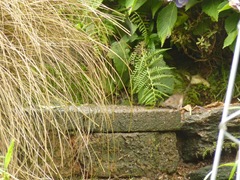
gallops across to the rowan tree, too quick for the camera to catch.
He roots among the discarded sunflower husks under the feeders looking for seeds that have been tossed aside by my wastrel birds.

He stuffs his cheeks and heads back for his burrow.
He seems unaware that he is being closely monitored and not just by me. A well camouflaged Grande Dame hides in the grass above the step. She watches but she doesn’t pounce. Maybe October isn’t the mousing season,


or maybe two mice are too much for ole fatso to handle.

Mr and Mrs working together.
I have visions of them curled up together in January, sleeping on their mound of sunflower seeds, mouse treasure more valuable than a dragon’s hoard.


